


Guide · Updated November 2026
Is my card worth grading? Four checks before you pay the fee
Grading fees, shipping and weeks of turnaround add up quickly. Most wasted submissions fail one of four checks you can run at your desk in five minutes: centering, physical defects, the raw-versus-PSA-9 floor and break-even math.


The four checks
Check 01
Measure centering, do not eyeball it
PSA 10 requires up to 55/45 on the front and 75/25 on the back. A 58/42 front often looks fine to the eye and comes back a 9. Measure both sides first with our free card centering calculator.
Check 02
Inspect under angled light out of the sleeve
Check all eight corners (front and back) for white dots, inspect edges for factory nicking, and tilt the holo foil under a bright lamp to spot print lines or tiny dents.
Check 03
Check the PSA 9 downside
Look at recent completed sales for raw, PSA 9 and PSA 10. On modern singles, PSA 9 often sells near raw, meaning a 9 loses your grading and shipping fees. Vintage cards behave differently because 8s and 9s often carry strong premiums.
Check 04
Run the fee & break-even math
Add the submission tier fee, insured round-trip shipping and marketplace selling fees, then check what probability of a 10 you need to beat selling raw. Open the grading ROI calculator
Screening a stack with GlintGG Grade
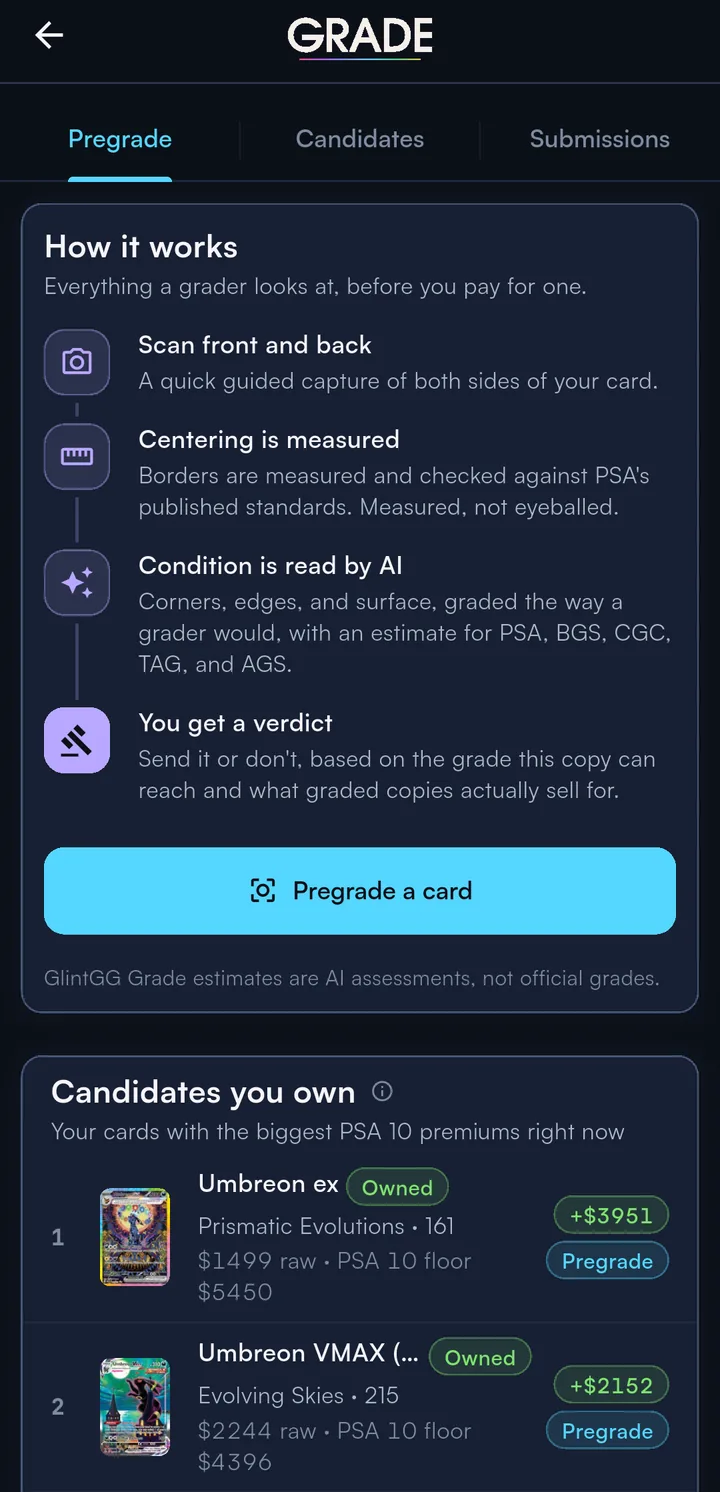
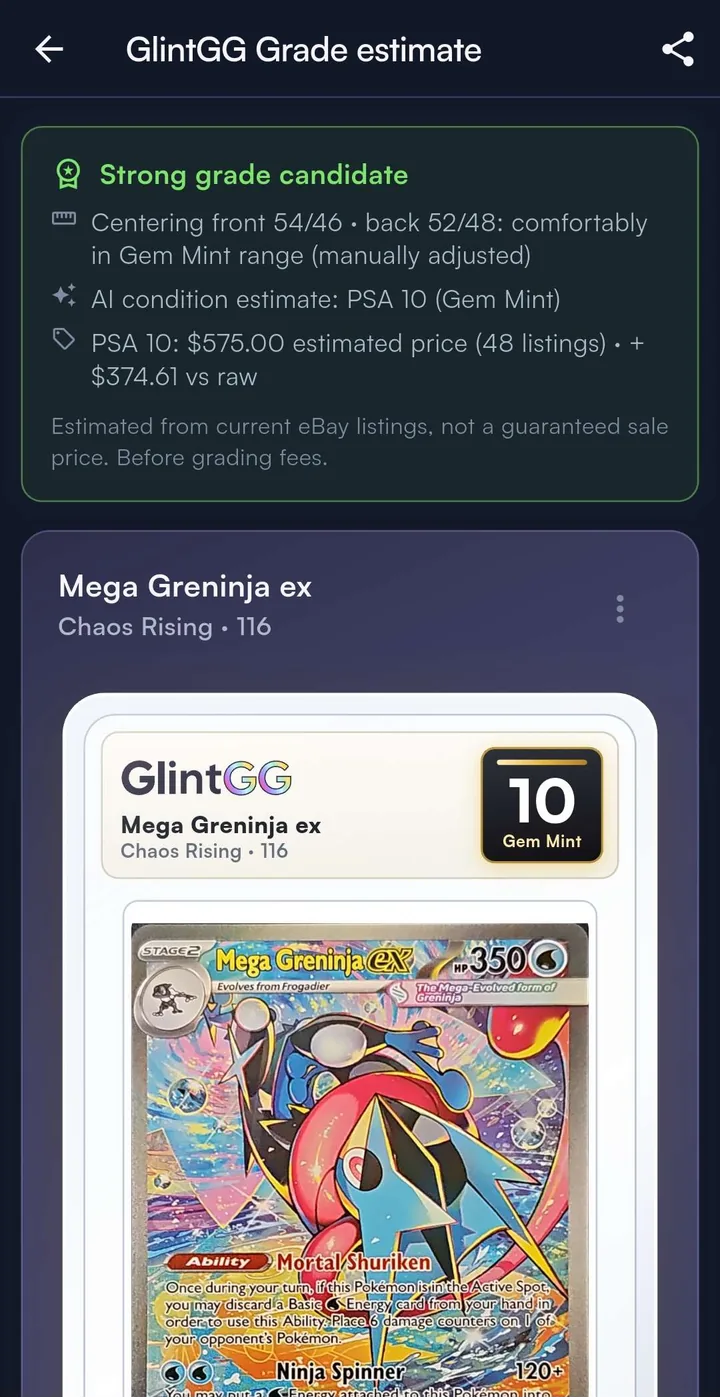
If you have a binder of pulls to sort through, GlintGG Grade (included in GlintGG Pro) surfaces the cards you already own with the largest PSA 10 premiums, walks you through front and back capture, measures centering, assesses corners, edges and surface, and gives estimates for PSA, BGS, CGC, TAG and AGS.
GlintGG Grade estimates combine measured centering with AI condition assessment. They are not official grades. Always pair a pre-grade estimate with a careful physical inspection under good lighting before paying grading fees.
Quick rules of thumb
When to keep a card raw
- The PSA 10 sale price minus grading fees, shipping and selling fees is less than raw value.
- Front centering measures worse than 55/45 and PSA 9 does not pay for the grading fee.
- There is a visible crease, dent or noticeable corner whitening on a modern card where only a 10 pays off.
- You want to sell immediately and cannot wait out turnaround times while set prices move.
Questions
When is a Pokémon card worth grading?
A card is generally worth grading financially when your expected graded sale value minus grading fees, insured round-trip shipping and selling fees clearly beats what you would net selling the card raw. For modern cards where a PSA 9 sells near raw, the card usually needs a strong shot at a PSA 10.
Should I grade a card that looks like a PSA 9?
Check the numbers first. On many modern English Pokémon singles, a PSA 9 trades close to the ungraded near-mint price, which means grading fees erase the profit. On vintage holos, low-population promos and high-dollar chase cards, even a PSA 8 or 9 can carry a meaningful premium over raw.
How strict is PSA 10 centering?
PSA's published Gem Mint 10 standard allows up to 55/45 centering on the front and up to 75/25 on the back. Measure both sides before submitting so an obviously off-center card does not cost you a submission fee.
What flaws drop a pack-fresh card below a 10?
Common pack-fresh downgrades include off-center cuts beyond 55/45, tiny white dots on back corners, silvering or rough factory cuts along edges, print lines across holo foil and minor surface dings.
Can I screen my card before paying PSA, BGS or CGC?
Yes. You can measure front and back centering for free in your browser with the GlintGG centering calculator, model net profit with the grading ROI calculator, or run a full guided photo pre-grade with GlintGG Grade in the GlintGG mobile app.
Screen your cards before you submit.